
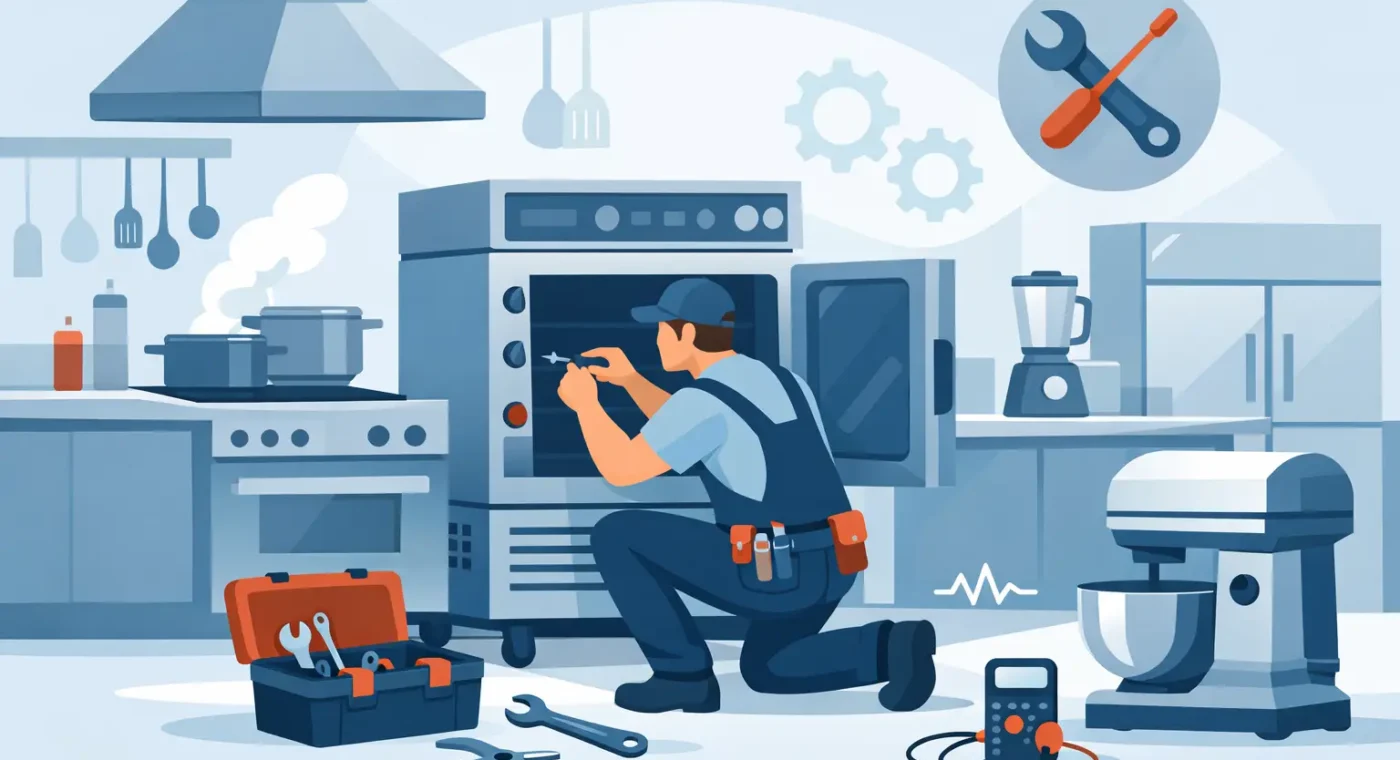
A prep cooler goes down an hour before lunch, the fryer stops holding temperature during the dinner rush, or the ice machine starts leaking into the back line. That is when commercial kitchen equipment repair stops being a maintenance task and becomes an operations problem. Every minute of downtime affects tickets, staff flow, food quality, and revenue.
For restaurant owners, kitchen managers, and property managers, the real issue is not just whether a machine can be fixed. It is how quickly the problem can be diagnosed, whether the repair will hold, and how much disruption the process will cause. In a working commercial kitchen, speed matters, but so does getting it right the first time.
Why commercial kitchen equipment repair matters more than most operators think
When a piece of equipment fails, the visible cost is obvious. You lose output, delay orders, and may need to pull items from the menu. The less obvious costs can hit harder. Food can move out of safe holding temperatures. Staff may need to work around a broken station. Other equipment may be overused to compensate, which creates a chain reaction of wear and tear.
That is why commercial kitchen equipment repair should never be treated as a last-minute scramble if it can be avoided. A fast, professional repair protects more than the machine itself. It protects workflow, compliance, customer experience, and daily revenue.
It also helps you avoid the expensive middle ground between minor repair and full replacement. Many operators replace equipment too early because they are tired of recurring problems, while others wait too long and spend more on emergency calls, spoiled product, and temporary workarounds. The right decision depends on the age of the unit, the availability of parts, how critical the equipment is to service, and whether the underlying issue has been identified correctly.
The most common equipment failures in commercial kitchens
Most service calls are not random. Commercial kitchens are high-heat, high-grease, high-volume environments, and certain systems fail more often than others. Refrigeration units commonly struggle with condenser coil buildup, fan motor issues, thermostat problems, door gasket wear, and refrigerant-related faults. Cooking equipment often shows ignition failure, burner inconsistency, thermostat drift, heating element burnout, and control board problems.
Dishwashers and warewashing systems can develop drainage issues, scale buildup, pump problems, and inconsistent heating. Ice machines are especially sensitive to water quality, mineral deposits, clogged filters, and neglected cleaning cycles. Ventilation-related equipment may also create secondary issues when airflow is restricted, especially in kitchens where grease accumulation is not managed consistently.
The important point is that symptoms can be misleading. A cooler that is running warm may not need a compressor. A fryer that recovers slowly may have a calibration issue rather than a complete heating failure. Good repair work starts with accurate diagnosis, not guesswork.
What to do when equipment fails during service
In the middle of a shift, the priority is containment. Protect food safety first, then reduce operational disruption. Move temperature-sensitive inventory if refrigeration is affected. Shut down unsafe equipment rather than forcing it to keep running. If there is an electrical smell, tripping breaker, exposed wiring, gas issue, or active leak, stop using the unit immediately.
From there, document the symptoms clearly. Note whether the problem is constant or intermittent, whether any error codes appeared, and what changed before the failure started. That information helps a technician shorten diagnosis time and improves the chances of a first-visit repair.
This is also where working with a service company that understands multiple systems can make a difference. In some kitchens, the problem is not only the appliance. A voltage issue, ventilation problem, drainage backup, or related electrical fault may be part of the failure. When service is coordinated properly, you waste less time bouncing between different contractors.
Repair or replace? It depends on more than age
Operators often ask the same question first: should we fix it or replace it? There is no single rule that works for every kitchen. Age matters, but so do repair history, part availability, equipment condition, and how central that unit is to production.
If a unit has been reliable and the current issue is isolated, repair is often the smart move. If the equipment has frequent breakdowns, rising operating costs, and parts that are hard to source, replacement may be more cost-effective even if the machine still technically runs. A low-cost repair on an unstable unit can turn into repeated downtime.
The strongest service providers will be honest about that trade-off. They should not push replacement when a repair is practical, and they should not patch a failing unit just to delay the real decision. Transparent pricing and a clear explanation of the fault help owners make better calls under pressure.
What professional commercial kitchen equipment repair should include
Fast response is important, but speed without process creates repeat problems. Reliable commercial kitchen equipment repair should begin with a focused diagnosis, followed by a clear explanation of what failed, what parts are needed, and what the expected repair path looks like. You should know whether the issue can be solved on-site, whether special-order parts are involved, and whether temporary operating adjustments are recommended.
Professional service also means looking beyond the failed component. If a motor burned out because airflow was blocked or if an electrical component failed because voltage was unstable, replacing the part alone will not solve the real problem. Good technicians look for cause, not just damage.
Just as important, the service experience should reduce stress instead of adding to it. That means showing up when promised, communicating clearly, providing fair pricing, and respecting the urgency of a working kitchen. For busy operators, that reliability is part of the repair.
How preventive service reduces emergency calls
Most emergency failures give warning signs first. Doors stop sealing tightly. Temperatures drift a few degrees. Recovery times get slower. Unusual noise starts and then becomes routine. By the time the unit stops completely, the problem has usually been building for weeks.
Preventive service helps catch those changes early. Coil cleaning, calibration checks, electrical inspections, filter replacement, drainage cleaning, gasket inspection, and burner performance checks are not glamorous tasks, but they reduce breakdowns. They also help equipment run more efficiently, which matters when energy costs are high and margins are tight.
That does not mean every kitchen needs the same maintenance schedule. A high-volume restaurant, hotel kitchen, commissary, or care facility may need more frequent service than a lighter-use operation. Equipment type matters too. Ice machines and refrigeration often need more consistent attention because even minor neglect can create food safety and sanitation issues quickly.
Choosing a repair partner for your kitchen
When you need service, the cheapest quote is rarely the full picture. What matters is whether the company can respond quickly, diagnose accurately, and stand behind the work. Commercial kitchens need technicians who understand urgency, safety, and the cost of extended downtime.
Look for a provider with licensed, experienced technicians, transparent pricing, and a clear service process. Free estimates can help with planning, but the bigger advantage is knowing what to expect before work starts. Availability matters too. Equipment failures do not wait for convenient hours, which is why 24/7 support is valuable for businesses that operate early, late, or around the clock.
There is also a practical benefit in working with a company that can handle more than one trade. If the issue touches electrical supply, ventilation, appliances, or related systems, coordination becomes easier. EAAIRS Services and Repair Ltd. is built around that kind of one-call convenience, which can save valuable time when several building systems overlap.
Small warning signs you should not ignore
A lot of costly failures start with symptoms that seem manageable. A freezer that occasionally runs warm, a range that heats unevenly, or a dishwasher that takes longer to finish a cycle may still be usable, but that does not mean it is healthy. Delaying service often turns a contained repair into a larger one.
The best time to call is usually before the equipment stops completely. If you notice temperature inconsistency, unusual sounds, water where it should not be, rising utility use, error codes, breaker trips, slow startup, or inconsistent performance, it is worth having the unit checked. Early diagnosis is almost always less disruptive than emergency downtime.
Commercial kitchens run on timing, consistency, and trust. Your equipment has to do its job without creating daily uncertainty. When something starts slipping, professional repair is not just about fixing metal and wiring. It is about keeping your operation steady so your team can keep moving.
One Reply on “Commercial Kitchen Equipment Repair Tips”