
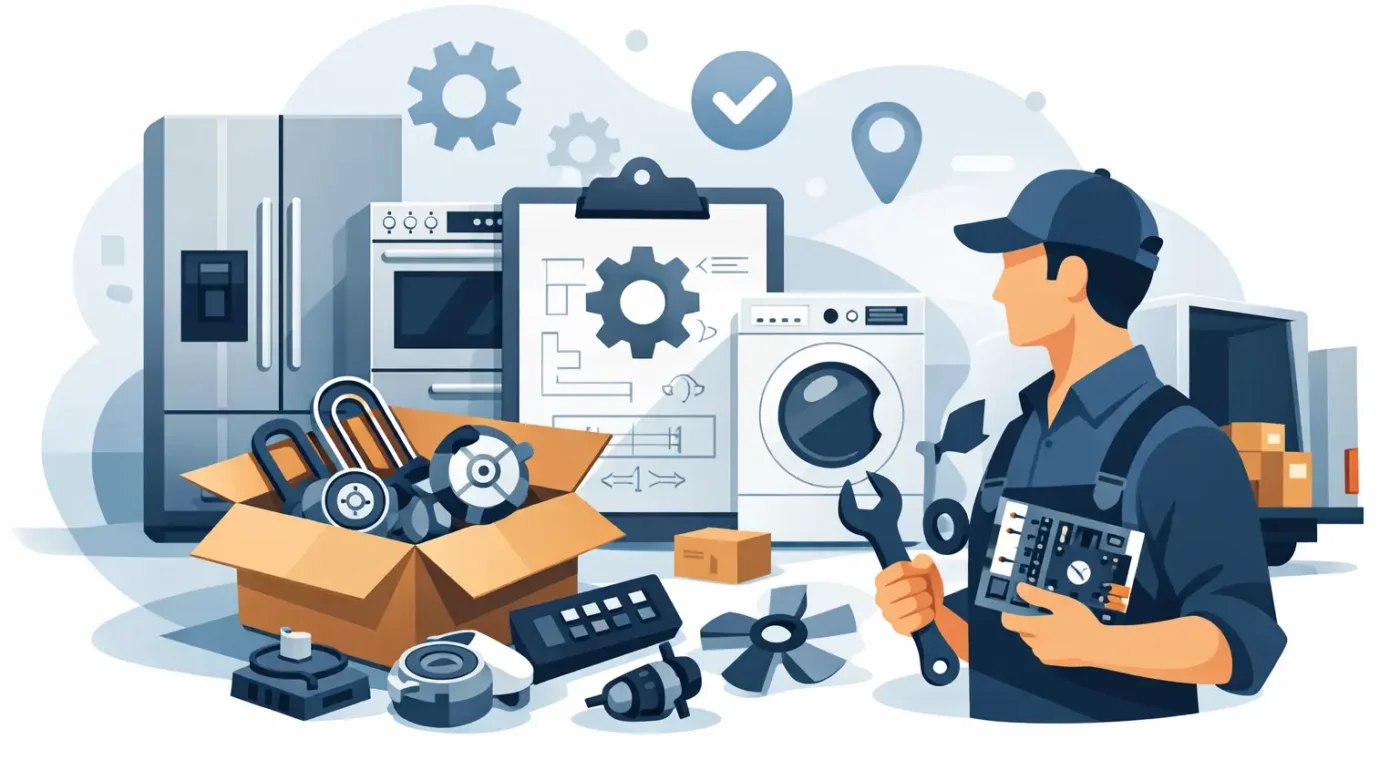
A refrigerator that stops cooling before a holiday weekend or a commercial oven that fails during service puts pressure on every decision. In many of those cases, the repair itself is straightforward. The real delay comes down to one thing – special order appliance parts.
When a part is not stocked locally or is tied to a specific model, ordering the correct component becomes the difference between a fast repair and days of avoidable downtime. For homeowners, that can mean spoiled food, laundry piling up, or a kitchen out of service. For property managers and businesses, it can mean tenant complaints, lost revenue, and unnecessary disruption.
What special order appliance parts actually means
Special order appliance parts are components that are not available on the technician’s truck or through standard local inventory. These may include manufacturer-specific control boards, uncommon motors, specialty igniters, custom shelves, sealed system parts, or model-specific door components.
That does not always mean the part is rare. Sometimes it simply means the appliance brand uses a variation that must be matched exactly by model number, serial number, and production series. Two units that look identical can still require different parts. That is why accurate diagnosis comes first.
In practical terms, a special order part is usually needed when the repair cannot be completed safely or correctly with a universal replacement. A good service company will verify the exact part before ordering, explain the timeline, and let you know whether repair is still the best value.
Why the right diagnosis matters before ordering
Ordering parts too early is one of the most common ways repairs get delayed. If the problem is misdiagnosed, the wrong part arrives, the appliance is still down, and the customer ends up paying with time and frustration.
A dependable technician starts by confirming the failure, not guessing. On a dryer that will not heat, for example, the issue might be the heating element, thermostat, thermal fuse, control board, or power supply. On a dishwasher that will not drain, it could be the drain pump, a blocked line, a wiring issue, or a control problem. The part should only be ordered after testing points to the real cause.
This is especially important with higher-cost parts. Electronic controls, compressors, inverter boards, and commercial components can be expensive. If a company skips the diagnostic process, the repair can quickly become more costly than it should be.
When special order appliance parts are worth it
Not every appliance should be repaired with a special order part. Sometimes it makes sense. Sometimes replacement is the better move. The right answer depends on the appliance’s age, condition, brand, and role in the property.
For newer units, especially mid-range and premium models, ordering a special part is often the smart choice. The appliance may have years of service left, and a targeted repair can restore normal operation at a reasonable cost.
For older units, the decision takes more care. If the part is expensive and the appliance is already showing multiple issues, it may not be worth waiting for a component that only fixes one problem. That is even more true when the appliance is near the end of its expected lifespan.
Commercial equipment is its own category. A special-order part for a restaurant refrigerator, cook line appliance, or commercial ice machine can still be worth it even at a higher price because downtime costs more than the repair. In those cases, speed, accuracy, and communication matter just as much as price.
How the ordering process should work
A professional ordering process should feel clear, not confusing. After diagnosis, the technician or office team should confirm the exact part using the model and serial information. They should explain whether the item is OEM, whether shipping timelines are estimated or confirmed, and whether labor will be completed once the part arrives.
Customers should also know what happens next. Will the office contact you when the part is received? Will a return appointment be scheduled automatically? Is there any deposit required for non-returnable items? These details matter because they set expectations and reduce back-and-forth.
Fast service is not just about overnight shipping. It is about organized follow-up, accurate part matching, and a team that does not let the repair stall after the order is placed. That is where experienced service providers stand out.
Common delays with special order appliance parts
The biggest delays usually come from part availability, shipping backorders, and incorrect identification. Some manufacturers change part numbers without notice. Others have multiple revisions for the same appliance family. If the original diagnosis was incomplete or the model details were entered incorrectly, the wrong part can arrive even when the ordering process looks fine on paper.
There is also the issue of supply chain timing. Some parts are available in a regional warehouse. Others may need to come from out of state or directly from the manufacturer. For certain brands, delivery windows can vary widely.
That is why honest communication matters. A reliable company will not promise same-day completion if a part is clearly on backorder. Instead, they will give you a realistic range, keep you updated, and help you plan around the downtime where possible.
Special order appliance parts for homeowners
For homeowners, the main goal is restoring comfort quickly without wasting money. If your refrigerator, oven, washer, dryer, or dishwasher needs a special part, the first question is not just how fast it can arrive. The better question is whether this repair solves the real problem at a fair cost.
A trustworthy service team should help you weigh the age of the unit, the value of the appliance, and the urgency of the issue. A five-year-old refrigerator with a failed fan motor is a very different situation from a fifteen-year-old washer with a failing transmission and signs of additional wear.
It also helps when the company handling the repair can manage related issues at the same time. If an appliance problem turns out to involve electrical supply, venting, or installation conditions, having one dependable service partner reduces delays and finger-pointing.
What property managers and landlords should look for
Property managers and landlords usually need more than a repair. They need a process they can rely on across multiple units and different types of tenants. When special order appliance parts are involved, speed and documentation become especially important.
You want clear diagnosis notes, transparent pricing, expected part timelines, and responsive scheduling once the component arrives. A repair that sits untracked for a week creates avoidable tenant frustration and puts pressure on your maintenance workflow.
This is also where working with a company that understands both appliances and broader building systems helps. If the issue involves power, ventilation, installation clearance, or a recurring operational problem, the repair can be addressed more completely instead of treated as a one-time patch.
Commercial downtime changes the math
For commercial operators, time lost often costs more than the part itself. A failed kitchen appliance can affect prep, service speed, food safety, and staffing. In these cases, special order appliance parts are not just a purchasing detail. They are a business continuity issue.
That is why commercial clients should look for service providers who move quickly from diagnosis to ordering to follow-up. You need accurate part sourcing, realistic scheduling, and technicians who understand the urgency of keeping equipment online.
At EAAIRS Services and Repair Ltd., that kind of responsiveness matters because commercial customers cannot afford long gaps between diagnosis and action. The best service experience is one where the problem is identified correctly, the part is tracked properly, and the repair is completed without unnecessary delay.
How to avoid wasted time and money
If your appliance needs a special order part, ask a few direct questions before approving the repair. Confirm that the diagnosis has been tested, not assumed. Ask whether the part is returnable, how long it is expected to take, and whether the appliance is otherwise in good enough condition to justify the repair.
It is also fair to ask about total cost upfront. That includes parts, labor, and any follow-up visit needed once the item arrives. Transparent pricing should not feel complicated.
The goal is not just to get a part on order. The goal is to solve the problem once, safely and correctly, with as little disruption as possible.
When an appliance is down, every day feels longer than it should. The right part, ordered for the right reason, can get your home or business back on track without guesswork – and that kind of clarity is worth a lot.
One Reply on “When Special Order Appliance Parts Make Sense”