
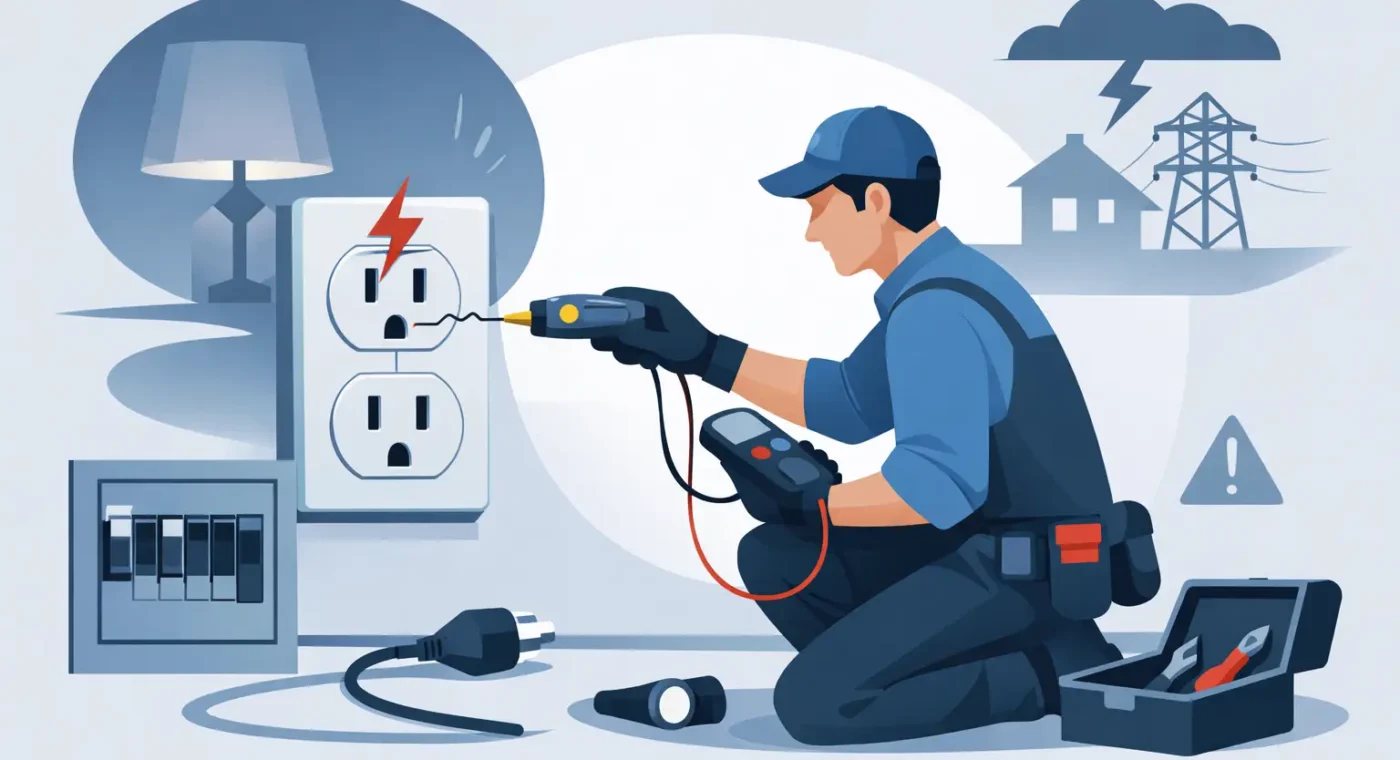
A dead outlet can stop a workday, leave food-service equipment offline, or turn a simple charging task into a bigger concern. Knowing how to troubleshoot outlet power loss helps you identify a few safe, obvious causes before deciding whether the issue needs professional electrical repair. The goal is not to take apart wiring or work inside a panel. It is to restore power safely and avoid turning a small fault into a shock, fire, or equipment-damage risk.
Start by Identifying the Scope of the Problem
Before touching anything, determine whether one outlet has lost power or whether the problem affects a larger area. Plug a device you know works, such as a lamp, into the dead outlet. Avoid using a phone charger alone as a test because a damaged charger or loose cable can make the result unclear.
Then test nearby outlets and lights. If only one receptacle is out, the issue may be a loose connection, a failed outlet, or a tripped protective device upstream. If every outlet in a room is dead, a circuit breaker, GFCI outlet, or wiring issue is more likely. When several rooms, major appliances, or your entire property are affected, check whether the utility service is out before assuming the problem is inside the building.
For commercial properties, note exactly what has stopped working. A single dead outlet near a prep station is different from an entire bank of receptacles serving refrigeration, point-of-sale equipment, or kitchen appliances. This information helps a technician diagnose the issue faster and reduce downtime.
How to Troubleshoot Outlet Power Loss Safely
Start with the simplest checks, and stop immediately if you see damaged wiring, smell burning, hear buzzing, or find an outlet that feels hot. These are not reset-and-continue situations. Turn off the affected circuit if you can identify it safely, keep people away from the area, and arrange professional service.
Check the Circuit Breaker Correctly
A breaker can trip without sitting fully in the OFF position. At the electrical panel, look for a breaker that is in the middle position or does not line up with the others. To reset it, move it firmly all the way to OFF first, then back to ON.
If the breaker immediately trips again, leave it off. Repeated tripping can point to an overloaded circuit, a short circuit, a damaged appliance, moisture exposure, or a wiring fault. Resetting it multiple times does not fix the cause and can create a greater safety risk.
If you are not sure which breaker controls the outlet, do not guess by turning off random circuits in a busy home or business. A licensed technician can trace the circuit without disrupting essential equipment unnecessarily.
Reset Nearby GFCI Outlets
Ground-fault circuit interrupter outlets, commonly called GFCIs, are designed to shut off power quickly when they detect a potential electrical hazard. They are common in bathrooms, kitchens, garages, basements, laundry areas, exterior locations, and commercial work areas where water may be present.
A tripped GFCI can disable other outlets connected downstream, including outlets in another room. Look for outlets with TEST and RESET buttons, then press RESET firmly. Check GFCIs in adjacent rooms, exterior areas, garages, utility rooms, and under counters. One tripped device may be the reason several outlets have no power.
If the GFCI will not reset, do not force it. It may not have power from the breaker, it may have failed, or it may be detecting a fault on the circuit. A professional inspection is the safest next step.
Unplug Recently Added Equipment
Outlet power loss sometimes begins after a new appliance, space heater, microwave, power strip, commercial device, or other high-demand equipment is plugged in. Unplug devices on the affected circuit, reset the breaker once, and see whether power returns.
Portable heaters, window air conditioners, hair tools, countertop cooking equipment, and extension cords are common sources of overloaded circuits in homes. In commercial spaces, added refrigeration equipment, warmers, coffee machines, and prep appliances can push an existing circuit beyond its intended load.
If power returns after unplugging equipment, the circuit may be overloaded or the device may be defective. Do not simply plug everything back in and hope for the best. A technician can evaluate whether the appliance needs repair or whether the circuit needs a dedicated line or upgraded capacity.
Signs the Outlet Itself May Have Failed
When nearby outlets work but one does not, the receptacle or the connection behind it may be the issue. Age, frequent use, loose plugs, heat, and improper past repairs can all cause an outlet to fail.
Do not remove the outlet cover or pull the receptacle from the wall unless you are qualified to perform electrical work. Even when an outlet appears dead, a wiring error or shared circuit can leave energized conductors in the box.
Instead, look for external warning signs. These include discoloration, cracking, melted plastic, scorch marks, a loose-fitting plug, buzzing, sparking, or warmth around the faceplate. Turn off the breaker if you can do so safely and call for service. An outlet that is hot or charred should be treated as urgent.
A dead outlet can also be caused by a loose connection at another outlet on the same circuit. This is especially common in older properties or circuits that have been heavily used. The failed connection may be out of sight, which is why a professional diagnosis matters even when the visible outlet looks normal.
Do Not Overlook Switch-Controlled Outlets
Some outlets are controlled by a wall switch, particularly in bedrooms, living rooms, offices, and older commercial spaces. Test the nearby switches before assuming there is a fault. A switch-controlled outlet may power only the top or bottom half of the receptacle, so test both plug openings if possible.
This can be an easy answer, but it should not distract from real warning signs. If the outlet works only intermittently, the switch crackles, or lights flicker when equipment is connected, schedule an electrical inspection. Intermittent power is rarely something to ignore.
When Outlet Power Loss Requires a Licensed Electrician
Some electrical problems are clear calls for professional help. Contact a licensed electrician promptly when a breaker keeps tripping, a GFCI will not reset, outlets are hot or damaged, power cuts in and out, or you smell burning. The same applies if you have water near an outlet, rodent-damaged wiring, aluminum wiring concerns, or an older panel with recurring issues.
Property managers should also act quickly when tenants report a dead outlet alongside flickering lights or unreliable power in other areas. What appears to be a single maintenance request may affect a shared circuit or signal a deteriorating connection behind a wall.
For businesses, avoid using extension cords as a permanent workaround for lost outlet power. Extension cords can create trip hazards, overload another circuit, and complicate code compliance. Fast electrical diagnosis protects staff, customers, inventory, and day-to-day operations.
A qualified technician can test the outlet, trace the circuit, inspect the panel, check for loose or damaged connections, and determine whether the repair involves a receptacle, GFCI, breaker, wiring section, or circuit upgrade. EAAIRS Services and Repair Ltd. provides dependable electrical support for homes and commercial properties, with clear recommendations focused on restoring safe, reliable power.
Prevent the Next Power Loss
Once power has been restored, pay attention to what caused the issue. Avoid overloading outlets with high-wattage devices, replace worn power strips, keep electrical connections dry, and do not rely on extension cords for permanent equipment. Larger appliances and commercial kitchen equipment may need dedicated circuits designed for their electrical demand.
Most outlet failures are manageable when addressed early. A quick reset may solve a minor interruption, but recurring trips, heat, damage, or inconsistent power deserve a professional response. Acting promptly keeps a small electrical issue from becoming a longer, more expensive disruption.