
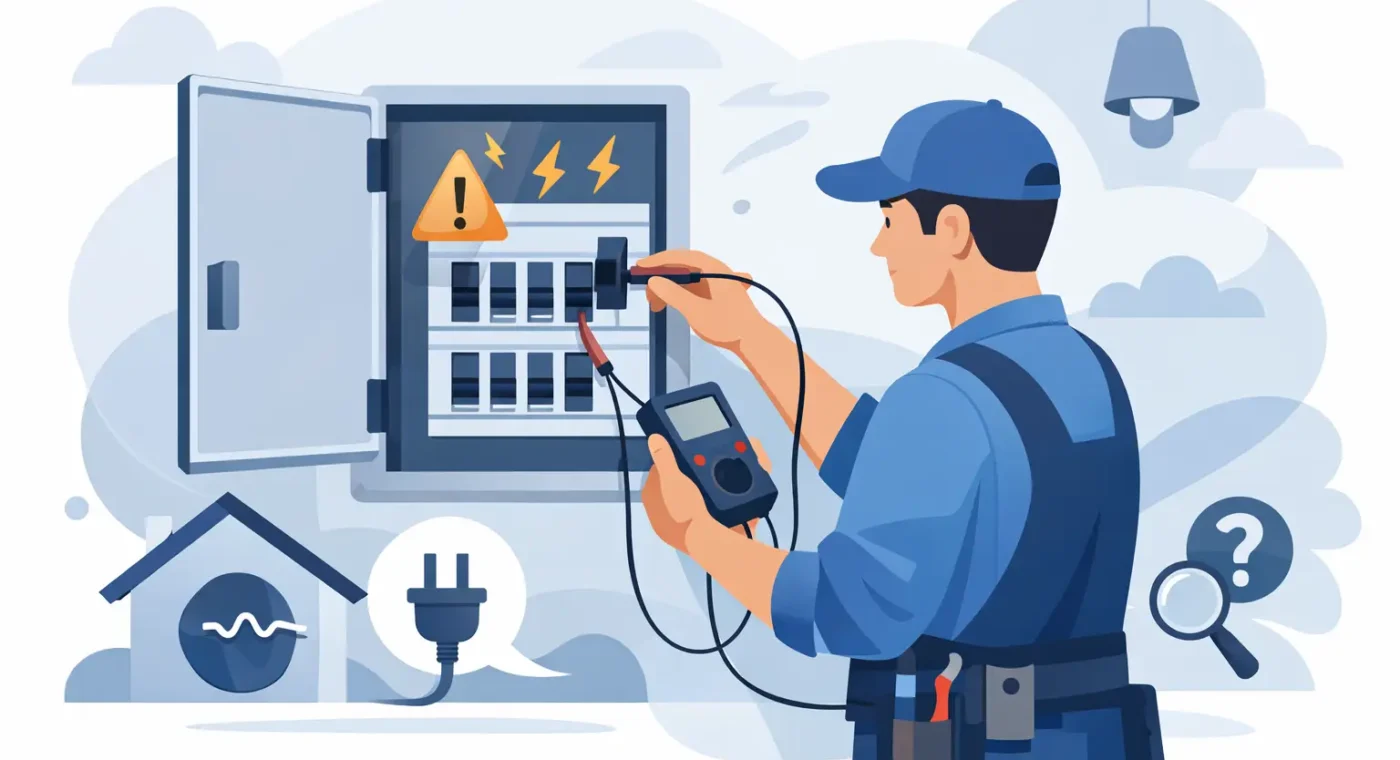
A breaker trips for a reason. When the lights go out in one room, the microwave stops mid-cycle, or a piece of equipment suddenly loses power, the goal is not just to turn everything back on – it is to find out what caused the shutdown in the first place. If you are wondering how to troubleshoot tripped breakers, the safest approach is to check for simple overloads first, rule out obvious appliance problems, and avoid resetting a breaker repeatedly.
A tripped breaker is your electrical system doing its job. It is designed to cut power when a circuit is overloaded, shorting out, or detecting a fault that could damage wiring or create a fire risk. Sometimes the cause is minor, like too many devices running on one circuit. Other times, it points to a more serious wiring issue that needs professional attention right away.
How to troubleshoot tripped breakers safely
Start at the electrical panel and look for the breaker that has moved to the middle position or fully to OFF. Many people miss this step because the handle does not always swing dramatically. To reset it properly, push it all the way to OFF first, then switch it back to ON.
If the breaker stays on, that does not automatically mean the problem is solved. Think about what was running when it tripped. Space heaters, microwaves, hair dryers, toasters, portable AC units, and commercial kitchen equipment can all draw enough power to overload a circuit, especially when used at the same time.
If the breaker trips again immediately, stop there. That usually means the issue is not a simple one-time overload. It could be a short circuit, a ground fault, a damaged outlet, or a problem inside one of the connected devices.
Start with what changed
One of the fastest ways to narrow down the cause is to ask a simple question: what changed right before the breaker tripped? In homes, it may be a new appliance, a holiday lighting setup, or a heater plugged into an already busy circuit. In commercial settings, it could be a recently installed appliance, added countertop equipment, or multiple devices starting up at once.
This matters because breakers often trip when a circuit that was already near capacity gets one more demand added to it. A refrigerator may run fine on a circuit for years, but if that same line starts carrying a microwave and a coffee maker, the breaker may begin tripping during peak use.
When nothing obvious changed, the issue may be wear and tear. Loose wiring, aging breakers, failing outlets, and equipment with internal electrical faults can all trigger repeated trips over time.
Unplug devices before resetting
A practical next step in how to troubleshoot tripped breakers is to unplug or turn off everything on the affected circuit before resetting the breaker. That includes lamps, countertop appliances, chargers, office equipment, and anything hardwired that can be switched off.
Once the breaker is reset, plug devices back in one at a time. Give it a moment between each one. If the breaker trips when a specific item is connected or turned on, that appliance or device may be the problem.
This method is useful because it separates circuit issues from equipment issues. If the breaker holds with everything unplugged but trips when one appliance comes back online, the appliance may be drawing too much current or may have an internal fault. If the breaker trips even with nothing connected, the problem is more likely in the wiring, outlet, switch, or breaker itself.
Watch for signs of an overload
Overloads are common and usually the simplest issue to correct. They happen when too many devices on one circuit demand more power than that circuit is designed to handle. The breaker trips to prevent overheating.
Typical signs include the breaker tripping only when multiple appliances run together, power loss in kitchens, bathrooms, laundry areas, or workspaces with heavy-use equipment, and a breaker that resets normally but trips again during busy periods. You may also notice lights dimming when another appliance starts up.
In that case, the solution may be as simple as reducing what runs on that circuit at the same time. But there is a trade-off. A temporary fix like moving appliances around may help, but if the space consistently needs more power than the existing circuit can provide, the better long-term answer is to have an electrician evaluate load distribution and possibly install a dedicated circuit.
Know when it may be a short circuit or ground fault
Not every tripped breaker is an overload. If a breaker trips the moment you reset it, or as soon as you plug in a certain device, that can point to a short circuit or ground fault.
A short circuit happens when hot and neutral wires touch somewhere they should not. A ground fault is similar, but the current moves to ground instead. Both conditions can be dangerous. They often come with warning signs such as a burning smell, scorched outlet covers, buzzing sounds, or visible damage to cords and plugs.
If you see any of those signs, do not keep testing the circuit. Leave the breaker off and have it inspected. The cost of a service call is small compared to the risk of damaged wiring, ruined equipment, or an electrical fire.
AFCI and GFCI breakers can be more specific
Some modern panels use AFCI and GFCI breakers, especially in bedrooms, kitchens, bathrooms, garages, laundry rooms, and outdoor areas. These breakers are more sensitive because they are designed to detect arc faults or ground faults, not just overloads.
That is good for safety, but it can make troubleshooting less straightforward. A breaker may trip even when the total electrical load seems normal. In these cases, the problem may be a damaged cord, moisture exposure, a worn outlet, or a wiring condition behind the wall.
If a GFCI or AFCI breaker keeps tripping and there is no obvious overloaded appliance, it is best not to guess. These protective devices are doing a specific job, and repeated trips usually mean something needs to be inspected more carefully.
When the breaker itself may be the issue
Breakers do not last forever. Over time, they can weaken, trip more easily than they should, or fail to reset properly. That does not mean every nuisance trip is a bad breaker, but it is one possibility, especially in older panels.
A failing breaker may feel loose, refuse to stay reset even when the circuit tests clear, or trip unpredictably without a clear pattern. The challenge is that these symptoms can overlap with wiring and device faults. That is why breaker replacement should not be treated as a guessing game.
An accurate diagnosis matters. Replacing a breaker when the real issue is damaged wiring does not solve the problem. It only delays it.
What not to do when a breaker trips
The biggest mistake is resetting a breaker over and over without checking the cause. If it keeps tripping, the system is warning you about a real fault. Ignoring that warning can overheat wires, damage appliances, and create a serious hazard.
It is also a bad idea to use extension cords as a long-term workaround, swap breakers without training, or install a larger breaker to stop nuisance trips. A larger breaker on undersized wiring is dangerous because it allows more current than the circuit can safely handle.
For property managers and business owners, there is another risk: downtime spreads fast. A single tripping circuit in a rental, office, or commercial kitchen can affect productivity, tenant satisfaction, and revenue. Fast diagnosis is often more valuable than repeated trial and error.
When to call a licensed electrician
There is a point where safe troubleshooting ends and professional service needs to begin. If the breaker will not reset, trips immediately, feels hot, smells burnt, affects essential equipment, or keeps tripping with no clear cause, it is time to bring in a licensed electrician.
This is especially true if the affected circuit serves major appliances, HVAC equipment, water heaters, or commercial systems. Those circuits often involve heavier loads and more complex troubleshooting. A trained technician can test the circuit, inspect connections, identify equipment faults, and make the right repair without guesswork.
For customers who need a fast answer, that is usually the most cost-effective path. EAAIRS Services and Repair Ltd. works with homeowners and businesses that need reliable electrical diagnosis, clear pricing, and prompt service when power issues interrupt comfort or operations.
A smarter way to prevent future trips
If breaker trips are becoming a pattern, the issue may be less about one bad event and more about how the property uses power now. Homes add appliances over time. Businesses add equipment, refrigeration, prep stations, and workstations. The electrical system may not have been designed for the current demand.
That is why prevention often starts with a load evaluation, not just a reset. In some cases, redistributing devices solves it. In others, dedicated circuits, outlet repairs, or panel work are the right fix. The best solution depends on the age of the system, the type of equipment involved, and how often the circuit is under strain.
A tripped breaker is frustrating, but it is also useful information. Treat it as an early warning, respond carefully, and if the problem is not clearly a simple overload, get it checked before a small interruption turns into a bigger repair.
One Reply on “How to Troubleshoot Tripped Breakers”